|
Joining Extension Homemakers is a great way to
get involved with and give back to your community.
If you are
interested in learning more, contact the Henry County Extension
office.

The Jericho Homemaker Club received
the 2016 Henry County Extension Homemaker Club of the Year Award.
Pictured L to R: Area Treasurer Irene Smith, Wanda Roberts, County
President Saundra Smith, Linda Noel, Carol Bryner,
Marcia Reider and
Area Environmental Chair Marian Call.
Fitness Beginnings: Exploring
little-known benefits to exercise
At one time or another, we have all heard that
exercise has benefits. Some of the most common benefits we tend to
hear about are how exercise can help lower your risk for chronic
diseases such as heart disease, stroke and diabetes, but the
benefits only start there.
It may sound funny that exercise can save you
money, but a study published in The Journal of the American Heart
Association shows that it does. Study participants who engaged in
moderate exercise for at least 30 minutes a day for five days a week
had significantly lower health care costs compared to those who did
not. Those who had heart disease and regularly exercised lowered
their health care costs by $2,500 a year compared to heart patients
who exercised little to none.
Exercise can also boost your brain. Numerous
studies of aerobic exercise show that it helps protect your memory
and helps fight off cognitive decline as you age.
It may also help you live longer. In addition to
lowering your risk for chronic diseases that could shorten your
lifespan, exercise lowers mortality rates from all causes of death.
It also helps slow the aging process.
Maybe you have taken a walk to calm down or relax
from a particularly stressful situation. There is a reason for that.
The benefits of moving makes people feel happier, according to
research. Physical activity can also help lessen symptoms of
depression, reduce stress and lower anxiety.
Now that you are ready to take in the benefits of
exercising, remember adults need 30 minutes of physical activity at
least five days a week. Children need at least an hour every day. If
it has been a while since you worked out or if you have certain
health conditions, consult your doctor before beginning any exercise
program. You may want to start slow. Any movement is better than
none. You can also split up your exercise up throughout the day,
such as three, 10-minute segments, to get the amount of exercise you
need.
For more information on the benefits of exercise,
contact the Henry Extension office.
May 2018
Home Vegetable
Gardening in Kentucky, provides information on planting dates and
care instructions for most vegetables. Both publications are
available online. Gardening in Small Spaces is available at
http://www2.ca.uky.edu/agcomm/pubs/ID/ID248/ID248.pdf. Home
Vegetable Gardening in Kentucky is at http://www2.ca.uky.edu/agcomm/pubs/id/id128/id128.pdf.
Support each other in times of
tragedy
Events that cause negative stress are known as
traumatic events. According to the Centers for Disease Control and
Prevention, traumatic events are “marked by a sense of horror,
helplessness, serious injury or the threat of serious injury or
death…and affect survivors, rescue workers, and the friends and
relatives of victims who have been involved.”
People who go through a traumatic event can
experience serious emotional distress. Furthermore, witnesses of an
event or those who watch an event unfold on television can also be
affected. Because traumatic events are recognized as a threat to
one’s own personal safety and/or the world, they often cause
physical, emotional and physiological distress and leave us with
unanswered questions and uncertainty. Traumatic events can include:
natural disasters, accidents, random violent acts like a school
shooting, other acts of terrorism and war. But they can also include
events such as moving to a new location, death of a family member or
pet, hospitalization or divorce.
Responding to these traumatic situations in a
productive manner can help us become stronger individuals and better
community and family members says Amy Hosier, extension specialist
for family life education.
Try not to compare yourself to others, as no two
people will respond to traumatic events the same way. Some people
may feel so numb, hollow or overwhelmed that they don’t even know
how to respond, while others respond with anxiety or feel as if
they’ve lost control, or experience grief and disbelief. Common
reactions to trauma also include rapid heartbeat, sweating, changes
in daily activity, sleeping and eating patterns, sensitivity to
lights and sounds, increased conflict in relationships, headaches
and nausea. It is not uncommon for children to experience
bed-wetting.
According to the CDC, many people do not start
feeling “normal” again for weeks or even months after a traumatic
event. If stress symptoms persist or get worse, a person could be
suffering from post-traumatic stress disorder, and a medical or
mental health professional should be contacted for consultation and
follow-up.
Research has shown that moving forward and
working at resolving one’s feelings at the time of a traumatic event
is beneficial. This helps a person re-establish a sense of safety
and trust. In a time of tragedy, be there for each other. Practice
patience and understanding with your family members, friends and
co-workers. Realize the additional stress may make them more
irritable than normal.
At times family members and friends may feel
helpless—not knowing what to do or how to help, but sometimes just
being there is more help than you realize. If someone wants to talk
to you about their feelings and the experience, encourage them and
let them share. Do not question whether you are the right person for
them to confide in and don’t worry about your response; they
identified you as someone who can listen and provide comfort and
support. Be careful not to force people to talk about their feelings
or share information about the traumatic event if they are not
ready.
Some people find it healing to volunteer to help
with recovery efforts in their community like taking food to
families struggling with the disaster or raising money to benefit
survivors. Others may want to join or start a survivors’ group where
they can discuss their feelings with others who have shared similar
experiences.
Be a friend to yourself and others. Recognize
that you and your family and friends will likely experience new or
different emotions after a tragedy and that it will take time to
heal. The CDC recommends individuals maintain their usual routine as
much as possible, be kind, turn to family, friends and community
members for support, and recognize when things are out of control
and help is needed. The American Psychological Association says
engaging in healthy behaviors such as eating well-balanced meals and
practicing relief through relaxation techniques can also help you to
cope with distress.
March 2018
The Multicooker
Craze
The “instant pot,” a small
kitchen appliance, is the latest craze to hit the culinary world
with consumers touting health benefits and ease of use in the trendy
appliance. Here is some information from our UK Extension
specialists on the multicooker.
The Instant Pot is just one
brand of multicooker. Several companies manufacture multicookers
like the Instant Pot.
Multicookers have several
different functions all contained in one unit. A single appliance
can be used to steam, sauté, brown, slow cook, pressure cook, make
yogurt or stir food while it is cooking. It depends on the unit
design and brand.
The multicooker offers some
great advantages over other machines. One appliance does it all so
there is no need to have several different ones taking up counter
space. The pressure cooker has several safeguards that have been put
in place to prevent the unit from exploding. It’s fairly quick and
easy to use. You can start off by browning or sautéing then
transition to a slow or pressure cooking method for the same pan
within seconds.
Before using, read the
manual to discover the features and become familiar with your new
appliance. Keep the manual with the appliance or in a handy location
for future use. Also, make sure to register your new appliance so
the manufacturer will have a record of your purchase in the event of
a malfunction or recall.
Depending on the unit size,
you may be limited on how much you can cook at once. You may need to
invest in additional dishes or pans, made specifically for use
inside the multicooker to get the most from your machine. For
certain functions, cooking times do not include pre-heat time. For
example, if a recipes says, “done in seven minutes,” you might need
to plan for an additional seven minutes heating time prior to
cooking and additional release times depending on natural or quick
release.
The multicooker is a small
appliance that might be something you will enjoy, and the more you
use it, the more comfortable and creative you can become when
preparing food. Later this spring we are hoping to get copies of a
new UK Publication on multicookers that is being written by an
equipment specialist for us.
Tax refund season: It’s like
Christmas come really early!
Or maybe it is just late? Either way, tax refund
season is an excellent opportunity to begin the New Year by making
wise financial decisions. According to the Internal Revenue Service,
the average tax refund in 2016 was about $3,050. Historically,
Americans have found a wide variety of uses for their tax refunds
which range all the way from saving to spending, and everything in
between. But maybe you have wondered, what should I be doing with my
tax return? Consider the following suggestions to guide your
decisions during the upcoming tax return season.
Contribute to an Emergency Savings Fund: Many
Americans don’t have adequate money in their emergency savings fund.
Most financial experts recommend saving at least 6 months of living
expenses. While that may seem an insurmountable goal, research has
indicated that most Americans don’t even have $400 saved for an
emergency so that might be a goal to start with. Without any savings
we are financially vulnerable in the case of job loss, illness, or
any other unexpected expense. Adding to your emergency savings will
make you more financially secure. Although it isn’t as fun or
exciting as buying a new vehicle or the latest technology,
contributing to your emergency savings is one of the wisest uses of
your tax refund.
Reduce or Eliminate Debt: Most Americans are
currently carrying some form of debt, whether it be credit card
debt, student loan debt, vehicle loans, etc. Using your tax return
to reduce high interest loan debt is a smart move because not only
will you reduce the principle, but you will also manage to reduce
the amount of interest you will owe in the future. Compare the
impact of putting your tax return in a savings account that earns 1%
interest vs. reducing credit card debt with an 18% Annual Percentage
Rate. Eliminating debt will give you much more bang for your buck.
Pay Yourself In the Future: For many people,
their first inclination is to treat their tax refund like an
unexpected windfall and to run out and spend that money immediately.
However, paying yourself now will not be nearly as wise as paying
yourself in the future. In other words, invest your tax refund to be
used at a later date. You can do this in a variety of ways like
starting a college fund for your children: whether you already have
kids or you plan to have kids in the future, it is never too early
to start saving. In an era of sharply rising costs of higher
education, saving for college is an excellent use of tax refund
dollars. Or you could contribute to your retirement: even if you
have been conscientious about contributing a portion of each
paycheck to your retirement savings, it can seem as though there is
never enough money to feel financially secure in the future. Pad
your retirement accounts with your tax refund. You might invest in
the stock market: although it would be advisable to address
outstanding debts first, investing in the stock market is a good use
of tax refund dollars because it has pretty consistently
outperformed savings accounts, bonds, and Certificates of Deposit.
And lastly be sure to spend it wisely if you do decide you want to
spend it, do yourself a favor and spend it wisely. Use tax refund
dollars to improve your vehicle or your home because these expenses
pay dividends in the future as well.
February
2018
Mold and
Mildew
Mold and mildew are two
fungi that may appear from time to time in your home. They can
trigger allergic reactions or asthmatic complications for certain
people, so prompt removal is critical to protect your family’s
health.
Both mold and mildew are
types of fungi that grow in moist environments, spread easily and
live on various surfaces. Mildew is a type of mold that usually has
flat growth and remains on the surface. Mold contains multiple
identical nuclei and grows in patches of various colors and can
penetrate beneath the surface of an infected material.
If you notice mold’s musty
smell, locate the source and quickly fix the problem. Mold growth
requires moisture and high humidity, so lowering the humidity level
in your home is essential to stopping its spread. You can reduce the
humidity level in your home by running a dehumidifier, air
conditioner or furnace. If you use a humidifier in your home, shut
it off or adjust it if the relative humidity level gets higher than
50 percent. Repair any plumbing leaks immediately and eliminate as
many sources of moisture as possible. Increase air circulation in
problem areas, and use exhaust fans vented to the outside when
taking showers or cooking. Unvented kerosene or gas heaters produce
moisture from combustion and you should not use them where mold is a
problem.
Many times, with the proper
safety equipment, you can successfully remove small areas of mold in
your home. When removing mold, use a N95 or N100 respirator with a
NIOSH approval No. TC-21C or TC-84A. Wear eye protection, rubber
gloves and clothes that you can remove and quickly wash. Remove mold
from hard surfaces by scrubbing the area with dish detergent and
water. Rinse the area with clean water and quickly dry the surface.
It is impossible to completely remove mold from porous surfaces so
it is best to discard these materials.
Seek professional assistance
for mold removal if the moldy area is larger than 10 feet, has
significant water damage, is in your HVAC unit, was caused by sewage
or other forms of contaminated water, or if you have health concerns
that prevent you from removing the mold.
Ways to
save on winter heating costs:
With the winter we have had
thus far, chances are you’ve seen at least one or two high heating
bills. While home heating costs can put a strain on your wallet
during the winter, you can do certain things to save money on these
expenses while still keeping your home warm.
Sunlight, even in the winter, is a great way to add natural, free
warmth to your home. Open your blinds and curtains during the day,
particularly on south-facing walls as they get the most exposure to
the sun. As the sun sets, close them to help trap in the warmth.
Leaks in your windows and
doors can allow warm air to escape and cold air to come inside.
Check your home for air leaks, and fill gaps and cracks with caulk
or insulation. Air can also escape through your chimney. When you
are not using it for warmth, close your fireplace’s damper to keep
in warmth. Use area rugs on tile, wood or laminate floors to help
trap in heat.
Turn your thermostat down
when you leave the house for work or other extended periods of time.
This keeps you from paying for heat you are not using. When you
return, set the thermostat to the lowest comfortable setting. For
every degree you lower the thermostat, you can save about 3 percent
on your heating costs. Wear layers of clothing inside, and add extra
blankets to your bed or to help you stay warmer at a lower
temperature.
Ways to
Save on Convenience at the grocery store
Most of us love convenience,
especially when it comes to food. Convenience items are already
prepared and packaged, so that we have little work to do before
consuming the product. Convenience items are everywhere, but most
commonly found at the grocery. They also tend to be more expensive
than regularly packaged items.
You can purchase different
types of convenience items including scratch, semi-convenience,
convenient and ready-to-eat. A general rule of thumb is the more
time a food takes you to prepare, the cheaper it is, with
ready-to-eat options exhibiting the greatest costs.
For example, bagged lettuce
can cost three to four times more than if you purchase a head of
lettuce and shred it yourself. In the center aisles where you find
boxed packaged foods, 100-calorie pack snacks generally cost 20
percent to 100 percent more than the same item in a regular sized
package. In this case, the additional packaging leads to more costs.
You can make smarter
monetary choices at the grocery store by choosing wisely when it
comes to convenience items. First, invest time instead of money. For
example, purchase the whole head of lettuce and take the time to
prepare it on your own. Purchase a regularly packaged snack and use
the serving size on the nutrition facts label to make your own small
snack size.
Use the unit price to
compare similar items. The unit price is listed on the price tag
directly below the item on the shelf. The unit price gives us an
idea of how much the items costs divided by weight. Using this
number, we can compare foods that are the same but in different
sized containers or we can use it to compare brands. Your best value
will generally be the item with the lowest unit price.
Remember that purchasing
convenience items at the grocery store is not always a bad thing. It
is important that you recognize the best balance of time, quality
and cost that fits your and your family’s lifestyle. Make sure that
spending a bit more on convenience items truly adds value and not a
perceived value caused by good marketing.
For more money-saving tips
or a free copy of our text “Small Steps to Health and Wealth”,
contact the Henry office of the University of Kentucky Cooperative
Extension Service.
January 2018
Keep
warm this winter
As the mercury drops on the
thermometer, remember to stay warm both indoors and outdoors for
your health. This is particularly true for older adults as they tend
to lose body heat faster than younger adults.
Not staying warm enough can
lead to hypothermia. This condition occurs when your body
temperature drops too low. For older adults, that number is around
95 degrees F. Hypothermia can lead to many other health problems
including heart attack, kidney problems and liver damage. According
to the Centers for Disease Control and Prevention, more than half of
all hypothermia-related deaths are in adults 65 years and older.
You may not notice early
signs of hypothermia. They include cold hands and feet, a puffy or
swollen face, pale skin, confusion, anger and sleepiness. Later
signs of hypothermia include trouble walking or clumsiness; stiff,
jerky arm and leg movements; slow heartbeat; slow, shallow breaths
and blacking out. Shivering can be an early sign of hypothermia but
is not a guarantee. In fact, some people experiencing hypothermia do
not shiver at all.
Being outside during cold
weather or even inside a chilly house can cause hypothermia. Try to
stay inside on chilly days, especially those that are also windy and
damp. If you cannot stay in, remember to dress in loose fitting
layers to keep yourself warm and wear a hat and scarf as you tend to
lose a lot of body heat from your head and neck. Keep your
thermostat set at 68 degrees F or higher to make sure you stay warm
enough inside during the winter. Remember to also wear warm clothes
while inside and use blankets for additional warmth. If you are
worried about heating costs, close off doors and vents in unused
rooms. Keep the basement door closed at all times, and put rolled up
towels by doors to block drafts.
Medical conditions including
thyroid disease, diabetes, Parkinson’s disease, memory loss and
arthritis can make it harder for you to stay warm. Some prescription
and over-the-counter medications can also affect body heat. Talk to
your doctor about ways to stay warm if you have these conditions and
before you start or stop any medication.
If you think yourself or a
loved one is experiencing hypothermia, seek immediate medical
attention. For more information on weather-related issues or healthy
aging, visit your Henry County Extension office.
Navigating the holidays as a caregiver
Caregiving can be stressful,
and these stresses can be elevated around the holidays as you are
faced with added responsibilities and obligations. Whether this is
your first holiday season as a caregiver or you have been providing
care for years, you can do several things to make the holidays
easier on you, the person you’re caring for and your extended family
and friends by following the recommendations below.
1. Plan ahead. This includes
shopping for gifts and food for holiday meals well in advance of the
holiday. Doing so can minimize the chances you will feel rushed or
stressed as the holiday approaches.
2. Prepare your guests. This may be the first time your guests will
see their loved one since you became their caregiver, and you don’t
want your family members or the person you’re caring for to be
frustrated or embarrassed by their health situation. Remind your
guests of any physical and mental limitations your loved one may
have. Celebrate the holidays where the person you are caring for
resides. This can keep their stress levels lower, as they don’t have
to worry about traveling or being in an unfamiliar environment.
3. Ask for help. Have someone run errands for you, such as mailing
Christmas cards or picking up items from the grocery store, or have
them stay with your loved one so you can do those tasks. Most people
are happy to help if you ask.
4. Take time for yourself. Take a break from caregiving and holiday
planning to do something that you really want to do. Simple things
such as taking a winter walk or enjoying coffee and a conversation
with a friend can help to improve your spirits.
For more information on caregiving or holiday survival tips,
contact, the Henry County Cooperative Extension Service or check out
the AARP Prepare to Care Family Caregiving Guide on-line.
Protecting Your Identity During the
Holiday Season
The holiday season is in full swing! It’s one of
the busiest times of year, as we are often juggling office and
school holiday parties, gift purchasing, and family celebrations.
The winter holiday season is also the biggest shopping season of the
year. Holiday shopping hotspots, including both brick and mortar
shopping centers and online retailers, are primary targets for
identity thieves. There are simple steps that you can take to help
protect yourself this holiday season (and year round).
Be aware of your surroundings while shopping. Is
someone standing too close behind you in line? Is the person taking
pictures with his/her cell phone? These could be signs of
“shoulder-suffers” who try to take a picture or write down your
credit card information from behind. To limit the opportunity of
shoulder-suffers only have your credit card out while your
transaction is taking place and use your hand to cover important
information such as your credit card number, pin number, and name.
Limit what you bring shopping. When you are
shopping, it is important to have your hands free. Limit the extra
items you bring while shopping so that you are not constantly
setting down and picking up a purse or other items that could be
left behind. It is important to carry your driver’s license, but do
not bring extra credit or identity cards with you. Your social
security card should definitely be left at home in a safe place.
Protect your smartphone. Smartphones are designed
to put information at our fingertips. Many people use their
smartphones for banking, online shopping, and to track personal
information. Consider having safeguards in place on your smartphone
in case it is lost or stolen, so that someone will not be able to
instantly gain access to all of your personal information. If your
smartphone has an auto-lock, consider setting up a unique
pass code. The automatic log-in on apps and the “rememberme” feature
on websites can be very handy; however, they also allow a thief
instant access to your personal information.
Shop with cash or credit. Shopping with cash is a
great way to limit your holiday spending and stay within your
budget. However, some individuals may find it more practical to shop
with their credit or debit card. Use your credit card instead of
your debit card. Your credit card will offer additional protections
if it is lost or stolen unlike your debit card.
Be mindful of your accounts. It is easy to
overspend during the holiday season. Being mindful of your accounts
and transactions will help you stay within your budget, and aware of
any fraudulent activity. Double check your transactions to make
certain that they match your purchases. Often credit card thieves
will make small dollar amount purchases to make transactions on your
bill less noticeable.
When shopping online, you enter a tremendous
amount of personal information including your name, phone number,
address, not to mention your credit card information. Always make
certain that you are using a personal/home computer for online
shopping. Public computers, such as those at work or the public
library, may store your information that someone could access later.
Be certain the website you are using is secure. Once you enter into
the shopping cart phase of a website, the web address should have an
“s” after the http. The “s” indicates that your data will be
transmitted securely. Also, be certain that you are on a legitimate
retailer’s site. Knock-off websites do exist and at times it may be
difficult to tell the difference from the legitimate site.
Safeguarding your identify is important regardless of the time of
year. These strategies to protect your identity are easy and quick
to introduce into your shopping routine, and will keep your holiday
season happy and financially secure.
December 2017
Holiday
Shopping Season is Upon Us
Although Thanksgiving is
barely over, the holiday shopping season will soon be here! Holidays
are often an exciting time of the year. Spending time with family,
enjoying time off work, and celebrating with family traditions are
enjoyable activities. However, the holidays also can represent added
stress due to the crunch on your wallet. Decorations, gifts, and
food expenses add up quickly. The month of December can be very
expensive, in terms of holiday spending.
Holiday shopping can be both
a rewarding and stressful experience. Every year, millions of
Americans flock to retail and online stores to buy gifts for their
family and friends. Unfortunately, poor planning and the pressure to
buy the perfect gift often leave many families in debt in the months
following the shopping season. If you are worried about overspending
this year, the following tips will help you to develop a plan for
buying gifts for everyone on your list without breaking the bank.
1. Establish a budget.
Before you even think about stepping foot in a store, prepare your
holiday shopping budget. To do this, make a list of everyone who you
are planning to buy for and then determine how much money you are
able to spend on each person. No matter how small of a gift you
intend to give, it is important to include it in your budget.
2. Use cash. When doing your holiday shopping, use either cash or
debit and avoid using your credit card whenever possible. Using cash
or debit forces you to avoid spending money that you don’t have.
Additionally, using a credit card most likely means that you will be
paying interest on your holiday purchases.
3. Do not open department store credit cards. When you are at the
cash register this holiday season, the sales associate will most
likely offer you an attractive discount on your purchase in exchange
for opening a department store credit card. However, that discount
will quickly disappear if you are not able to pay your credit card
balance in full. Keep in mind that these credit cards often come
with annual percentage rates of 20% or higher.
4. Do your research. Prior to heading out to the stores, take
advantage of the Internet. If you know exactly what you want to buy,
a quick Internet search will provide you with a list of prices for
any given item. Keep in mind that many stores price match, meaning
that if you wish to buy from a particular store, they may be able to
match the lowest price offered by their competitor.
5. Start
shopping early. Don’t plan on waiting for the “holiday season” to
arrive to start your shopping. You are likely to find great deals
all year round if you keep your eyes open. Starting your shopping
early will save you money and also cut down on the stress associated
with holiday shopping!
6. Track your spending. Be sure that you
keep track of your spending so that you know how much money you have
already spent before making additional purchases. This is
particularly important for shoppers who like to spread out their
holiday shopping over the course of the year.
7. Think about
what is important to your family. Before spending, think about what
it is about the holidays that your family considers most important.
Holiday traditions such as a big family meal may be more important
than being able to give a certain number of gifts.
8. Free gift
wrap. During the holiday shopping season, many retailers offer free
gift wrap. Taking advantage of these services will save you money on
gift wrapping supplies at home and time.
9. Do it yourself! If
you are feeling creative, consider making do-it-yourself gifts for
family and friends. Do-it-yourself gift wrap using supplies such as
newspaper or paper grocery bags is also a great way to save money
during the holiday season.
Keep these tips in mind
before your next holiday shopping outing. Remember that it is
important to budget and prioritize your holiday spending. Take a
moment to think about what is really important to you during the
holiday season and enjoy your family and friends!
November 2017
Socializing is important for your health
Just as we need food and
water to survive, we also need meaningful social relationships and
connections. Because we are wired for social contact, going without
it increases the risks to jeopardize our overall health, well-being
and life quality. While it is okay to feel lonely and to be alone at
times, chronic loneliness can cause serious health concerns.
Researchers continue to demonstrate how important meaningful
relationships with others are to our mental, emotional and physical
health.
Loneliness, if not
addressed, can lead to social isolation, physical and mental decline
and depression. Recent studies have shown that social isolation can
also lead to a number of negative health impacts, including poor
sleeping patterns, a disrupted immune system, poor nutrition,
destruction of arteries and high blood pressure. When the need for
socialization is not met, it can also negatively affect learning,
memory and motivation.
Loneliness can occur at any
age and can be a normal feeling—especially after a break-up, a move
to a new location, loss of a loved one or exclusion from a group.
But chronic loneliness—feeling lonely, isolated or not to close to
people for an extended period of time, can bring about discomfort
and distress, including feeling sad, empty, isolated, distanced from
others, deprived and filled with longing. These feelings lead to
many problems. Children and teens, for example, are more likely to
adopt an outcast status, have problems in or drop out of school or
even become delinquent. Lonely adults are at greater risk of
alcoholism and depression. Those living alone are at greater risk of
suicide.
Loneliness is particularly
prevalent among older adults. As we age, our social circle shrinks,
which makes it more difficult to have meaningful interactions with
others. According to a 2013 AARP study, the percentage of adults who
say they are lonely has doubled since the 1980s from 20 to 40
percent. About 30 percent of adults older than 65 live alone. That
number jumps to 50 percent in adults over 85.
If you are experiencing
loneliness, you are not alone, and you don’t have to be as there are
many ways to increase your social interactions.
Find a cause to be
passionate about and donate your time. There are many community
organizations in our community in need of volunteers. Not only will
you get to interact with others, but you will also get satisfaction
from giving back. Our Second Wind Dreams Committee meets the second
Tuesday of the month at 1:30 at the Extension Office and is a great
way to interact.
Don’t miss opportunities to
interact with your family. Attend family events, such as reunions
and weddings. If you have grandkids who live close, consider
attending one of their extracurricular activities, such as a
ballgame or a dance recital.
Take up a hobby. Find
something you are passionate about or learn more about something you
already enjoy. We are offering an open knitting and crochet class
every Thursday in October from 1:30 to 3:00 at the Extension Office,
and our Homemaker Book Club meets the fourth Wednesday at 1:30.
October 2017
Join
Extension Homemakers
If you are interested in
learning something new or giving back to your community, you may
consider joining the Kentucky Extension Homemakers Association.
Clubs across Kentucky are currently recruiting new individuals.
The goal of KEHA is to
improve the quality of life for families and communities. Each group
carries out this objective differently based on region or interest.
More traditional groups
focus on food, nutrition, health and family development while other
groups delve into cultural arts, heritage and 4-H. Anyone can join
KEHA and find a group that suits their specific interests. Emerging
special interest clubs have cropped up in several counties including
cooking, quilting and photography groups in Henry County we are
thinking about trying to start a Pinterest Club and possibly a
knitting and/or crochet group. One of the more important aspects of
KEHA is the group’s commitment to volunteer service. In the past
year, KEHA raised $37,257 for the University of Kentucky Ovarian
Cancer Research and Screening Program. Likewise, KEHA members
donated 1,080 pillowcases and more than 200 quilts and comforters to
the Center for Courageous Kids in Scottsville, in Henry County
Homemakers donated $990 in 4H Camp Scholarships to Henry County
4Hers.
KEHA’s longstanding history
of excellence in community and leadership development across the
state has been a way for many homemakers to dedicate a portion of
their time to volunteer service and to their families and
communities.
If you are interested in
joining KEHA, visit http://keha.ca.uky.edu or contact the Henry
County Extension office to learn more about local clubs and
opportunities. We currently have 9 clubs meeting in Henry County,
some meet during the day and others at night.
At the
farmers market:
Look for plump, fresh berries that are uniform in color. Ideally,
they should not have any stems or leaves attached. Avoid moldy,
crushed or bruised fruit. Do not use berries that have moisture
leaks staining the carton. Store berries unwashed and covered in a
refrigerator. Use within two days for optimum flavor and texture.
Contact the Henry
County Extension office for more information on ways to prepare
in-season produce or about our local farmers market offerings. For
more Plate It Up! Kentucky Proud recipes, visit
http://fcs-hes.ca.uky.edu/piukp-recipes or contact the extension
office for recipe cards. Plan to stop by the Henry County Farmers
Market where WIC/SR Farmers Market Coupons are accepted. They are
located at the Courthouse Lawn in New Castle on Wednesday and
Saturday mornings and give this unique Very Berry Salsa recipe a
try:
Very Berry
Salsa
Ingredients:
4 cups apples, finely diced
1 cup blueberries
1 cup strawberries, diced
1 cup raspberries, halved
1 cup blackberries, halved
1 tablespoon fruit preserves
½ tablespoon sugar
½ tablespoon brown sugar
Yield:
32, 2 ounce servings
Directions:
In a large bowl, combine apples and berries. In a small
bowl, mix together preserves and sugars until well blended.
Pour preserve mixture over fruit and toss to coat. Cover and
chill in the refrigerator for at least 30 minutes.
Nutritional
Analysis:
20 calories, 5 g carbohydrate, 1 g fiber, 4 g sugar.
August
2017
Pedestrian Safety
Walking and running may seem
like two of the simplest ways to get healthy, but it’s important to
remember to stay alert when you exercise on sidewalks and along
roadways.
Whether you are a pedestrian
or a driver, it’s vital for you to be cautious and courteous to
others. Remember not one group has sole rights to the road. We must
share it with others. Here are some safety tips for drivers and
pedestrians.
Pedestrians:
• Wear bright colored
clothing and reflective materials to make sure others can see you,
particularly if you exercise at dawn or dusk.
• Walk on the sidewalk when available. Walk facing traffic if there
is no sidewalk.
• Cross at designated crosswalks and intersections.
• Wait for a walk signal and make eye contact with drivers before
crossing at an intersection.
• Listen for engines or look for backup lights if walking in a
parking lot or near driveways. Don’t use electronic devices or wear
headphones when crossing the road.
• Exercise in familiar areas and with a partner if possible.
• Tell a family member, neighbor or friend where you are going and
when you should return.
• Trust your intuition and avoid situations or people that do not
seem right.
Drivers:
• Understand that bicyclists
and pedestrians have the same rights to the road that drivers do.
• Slow down at crosswalks or intersections and be prepared to yield
to pedestrians. In Kentucky, it’s the law.
• Never try to pass a vehicle stopped at a crosswalk.
• Be cautious and look for others when backing up.
Broccoli actually has two growing seasons in
Kentucky. Kentucky growers began harvesting their first crop in May
and will continue to harvest through early July. The second season
ends with a harvest in the late fall.
You can steam, boil or microwave broccoli or enjoy it raw. As you
will see in the Plate It Up Kentucky Proud recipe below, it can give
a flavorful and healthy twist to popular summer dishes.
Good Eats from Local Farmers
Broccoli is one of the most nutrient-dense
vegetable that you can eat. It is a good source of vitamins A and C,
beta carotene, folic acid and phytochemicals. Researchers recommend
you consume several servings of broccoli and other cruciferous
vegetables like cauliflower, cabbage and Brussels sprouts several
times a week due to their high antioxidant levels. A diet high in
antioxidants can reduce your risk of developing some forms of cancer
as well as heart disease.
When shopping at the market, choose broccoli that
has tender, young and dark-green stalks with tightly closed buds. If
you purchase about 1.5 pounds of broccoli, you’ll get four, one-half
cup servings. Store broccoli, unwashed, in the refrigerator for no
more than three to five days in a perforated plastic bag. Wash just
before preparing to maintain its texture and prevent mold from
forming.
Contact the Henry Extension office for more
information on ways to prepare in-season produce or about our local
farmers market offerings. For more Plate It Up! Kentucky Proud
recipes, visit http://fcs-hes.ca.uky.edu/piukp-recipes or contact
the extension office for recipe cards.
Broccoli Grape Pasta Salad
Ingredients:
3/4 cup diced pecans
8 ounces whole grain pasta (bow tie or other)
5 slices turkey bacon
2 cups seedless red grapes
1 pound fresh broccoli
3/4 cup low-fat mayonnaise
1/4 cup honey
1/3 cup diced red onion
1/3 cup red wine vinegar
Yield:
16, 1/2-cup servings
Directions:
Preheat oven to 350 degrees Fahrenheit. Bake pecans in a single
layer in a shallow pan for five to seven minutes or until lightly
toasted and fragrant, stirring halfway through. Prepare 8 ounces of
pasta according to package directions. Cook bacon according to
package directions. Cool and crumble into small pieces. Cut the
broccoli florets from the stems and separate florets into small
pieces using the tip of a paring knife. Slice 2 cups of grapes into
halves. Whisk together mayonnaise, honey, diced red onion and
vinegar in a large mixing bowl. Add broccoli, cooked pasta and
grapes; stir to coat. Cover and chill for 30 minutes. Stir in bacon
crumbles and diced pecans, just before serving.
Nutritional Analysis:
160 calories, 7 g fat, 1 g saturated fat, 5 mg cholesterol, 125 mg
sodium, 24 g carbohydrate, 3 g fiber, 9 g sugar, 4 g protein.
If you are interested in preserving some of the
summer produce stop by the Henry County Extension Office for copies
of our food preservation publications. There is also a class being
offered at the Oldham County Extension Office on Thursday, June 8 at
6:30 p.m. and Friday, June 9 at 10:00 a.m. The classes are free and
open to the public. Call 222-9453 to register. You will learn the
safest methods to preserve the summer bounty.
June 2017
You May
find Strawberries at the Farmers Market
The Henry County Farmers
Market is open again and they had strawberries this past week! A
perennial farmers market favorite, growers harvest Kentucky
strawberries during May and June. They are a very refreshing snack
and they are full of vitamins. Just one cup provides a great source
of vitamin C, which according to the American Cancer Society, could
help lower your risk of cancer and gastrointestinal tract problems.
They are also a good source of vitamin A, iron, fiber and folic
acid. Folic acid is a particularly important for pregnant women and
those trying to become pregnant, because it helps prevent certain
birth defects. As you will see in the Plate It Up Kentucky Proud
recipe below, it is a perfect low-calorie snack for an on-the-go
treat, as one cup only contains 55 calories.
When shopping for
strawberries at the market, look for bright red berries. The berries
should have a natural shine and be plump, as strawberries will not
ripen further after picking. Use as soon as possible after
purchasing for optimal flavor and the highest nutritional value.
Store in the refrigerator for one to three days in any packaging.
Wash strawberries right before you eat them. When washing, make sure
that you do not remove the caps. These caps ensure that water does
not soak into the berry and dilute its flavor and texture. To dry,
simply place them on a paper towel and enjoy with any dish.
Contact the Henry Extension
office for more information on ways to prepare in-season produce or
about our local farmers market offerings. For more Plate It Up
Kentucky Proud recipes, visit
http://fcs-hes.ca.uky.edu/piukp-recipes or contact the extension
office for recipe cards.
Spring Harvest Salad
Yield: 8, 1 cup servings
Ingredients:
5 cups of torn spring leaf lettuce
2 ½ cups of spinach leaves
1 1/15 cups of sliced strawberries
1 cup of fresh blueberries
½ cup of thinly sliced green onions
Dressing:
4 teaspoons lemon juice
2 ½ tablespoons of olive oil
1 tablespoon balsamic vinegar
1 ½ teaspoons Dijon mustard
2 teaspoons of Kentucky honey
½ teaspoon of salt
¼ cup of feta cheese crumbles
½ cup of unsalted sliced almonds
Directions:
Combine leaf lettuce and spinach leaves with sliced strawberries,
blueberries and green onions in a large salad bowl. Mix together the
lemon juice, olive oil, balsamic vinegar, Dijon mustard, honey and
salt. Pour the dressing over the lettuce mixture and toss to coat
the lettuce. Lastly sprinkle feta cheese and sliced almonds on top
and serve.
Nutritional Analysis:
130 calories, 9 g fat, 1.5 g saturated fat, 240 mg sodium, 12 g
carbohydrate, 3 g fiber, 7 g sugars, 3 g protein.
Saving Money at the Grocery Store
Do you find yourself spending more money than you
would like to at the grocery store? If so, you are certainly not
alone. According to the Bureau of Labor Statistics, food is the
third-largest household expense for American households. Much of the
expense associated with food shopping is due to overspending.
Fortunately, there are many ways that you can save money at the
grocery store without skimping on your needs! Below are some
suggestions that will help you to save on your next grocery shopping
trip:
• Make a grocery list.
Before you go to the store, make a grocery shopping list. It may be
helpful to have a bulletin board in your home for you and your
family members to mark down needed items throughout the week.
Additionally, use your grocery store’s weekly flyer to prepare your
list. Catering your meals and snacks around sale items will save you
the most money. Be sure that you buy only what is on your list.
• Use coupons. You can now find coupons in
grocery store flyers, magazines, newspapers, and online. Be sure to
clip coupons for your favorite products when you see them. Pay
attention to expiration dates – even if you are not planning on
using a product for a while, it may be worth it to buy the product
before your coupon expires. Additionally, consider saving your
coupons until the product that you are interested in buying goes on
sale to maximize your savings.
• Choose the grocery store that will give you
the most for your money. Smaller grocery stores are often
appealing because of their neighborhood charm but shopping at a
larger supermarket will offer you lower prices. Larger grocery
stores are able to buy stock in larger amounts which translates to
greater savings for you.
• Enroll in loyalty programs.
Many supermarkets offer loyalty programs. These programs will
provide you with exclusive access to sales and will also reward you
with points for your purchases. Loyalty points may often be redeemed
at gas stations or on future purchases.
• Snack before grocery shopping. Believe
it or not, eating a small snack before entering the grocery store
can save you money. Shoppers who enter the store with an empty
stomach are often tempted to make unnecessary purchases.
• Buy store brands. Store brands are
almost always cheaper than brand name products. If you are unsure of
whether or not you will like the store brand, consider buying a
smaller quantity to try. You can then make decisions on which store
brand items you prefer to buy.
• Compare prices based on the cost per unit.
You will find the cost per unit printed on the item’s label on the
grocery store shelf. The cost per unit tells you what the cost of
the item is per ounce, gallon, pound or any other unit of
measurement. Using the cost per unit for comparison shopping between
products will guarantee you the most savings.
• Avoid buying prepared products. Do the
work yourself! Buying a prepared product is usually more expensive.
For example, instead of buying broccoli florets buy a head of
broccoli and cut off the florets yourself.
• Buy produce when it is in season. You
will find the best deals on produce when you buy in season. When
your favorite produce items are not in season, consider buying these
items in the canned or frozen foods section – you will find lower
prices as well as fresher items.
By following these suggestions, you will become
an expert at saving money on your grocery shopping trips! Remember,
saving money at the grocery store is all about careful planning.
Also be sure to start checking out the great produce at our local
Henry County Farmers Market which will be opening on Saturday
mornings at the Courthouse lawn in New Castle, later in the season
they will be there on Wednesday mornings too. They will be accepting
WIC and Senior Coupons.
May 2017
Spring Allergies
Spring is a time for renewal, but if you suffer from seasonal
allergies this renewal can make this time of year miserable.
Hay fever, also called allergic rhinitis, starts with
cold-like symptoms. Unlike a cold that goes away in seven to 10
days, an allergic reaction tends to linger until its source is
identified and treated or no longer present. One of the most common
causes of allergies during the spring is high pollen counts.
Depending upon the type of pollen you are allergic to, this could
happen at various points in the season. Different types of pollen
peak at different times.
To reduce your exposure to pollen, monitor local pollen counts
and take necessary precautions when the type of pollen you are
allergic to is high. Precautions can include such things as starting
to take allergy medicines or closing the windows in your home at
night, as well as the following:
• Stay inside on dry, windy days.
• Change your clothes and shower after being outside to remove
pollen.
• Do not hang laundry outside.
• Avoid being outdoors in the morning, when pollen counts are the
highest.
• Use air conditioning to cool your house or car.
• Vacuum your floors often.
Seasonal allergies can develop at any time during your life
and are not necessarily something you are born with. Sometimes signs
of allergies aren’t straightforward, as it can be hard to
distinguish an allergy from the common cold. This is especially true
with children. If you or your child has cold symptoms that last more
than a week or seem to occur at the same time every year, you may
want to talk with your health care provider about it. Only a
certified health care provider can truly diagnose allergies and
prescribe treatments.
More information on healthy living is available at the Henry
Extension office.
April 2017
Colorectal cancer rates rise in
young adults
March is colorectal cancer awareness month.
Cancers of the colon and/or rectum have long been associated with
individuals over 50. While that age group still accounts for the
majority of cases, they are declining thanks to increased disease
awareness and preventative screenings. But diagnoses among adults in
their 20s and 30s are on the rise, according to a recent study
conducted by researchers with the American Cancer Society.
Since the mid-1980s, rates of colorectal cancers have increased by
2.4 percent every year for patients between 20 and 29 and by 1
percent each year for patients 30 to 39. As a result, those born
around 1990 have double the risk of developing colon cancer and a
quadruple risk of rectal cancer compared to people born in the
1950s.
While researchers have not yet determined the
cause for this increase, it’s important for young people to know the
symptoms of colorectal cancer and to see a medical professional if
they are experiencing them. These symptoms include blood in your
stool, change in bowel habits, cramps that don’t go away, a
sensation that there is always something in your bowel, narrow stool
and unexplained weight loss.
It’s important for you to know if colon cancer
runs in your family, as that increases your risk for getting the
disease. While you can’t control your genetics, you can control
several behaviors that may increase your risk for colorectal cancer.
These include:
• Physical inactivity
• Overweight and obesity
• Diet low in fruits and vegetables
• A low-fiber, high fat diet
• Heavy alcohol consumption (three or more drinks per day)
• Tobacco use
Research has shown obesity is a serious risk
factor for colorectal cancer. It has also shown that physical
activity can lower your risk of developing colorectal cancer. Strive
to increase your physical activity if you are sedentary. Some recent
studies also suggest that diets rich in whole grains, fruits and
vegetables may also help prevent the disease. Both diet and physical
activity can help you reach and maintain a healthy weight.
More information related to health and nutrition
topics is available through the Henry County Extension office.
Update on Whooping Cough:
You may have heard about the cases of whooping cough in
Lexington. Although most persons you may meet are vaccinated against
the illness, it is important to be aware of whooping cough, its
symptoms, and treatment.
Pertussis, commonly known as whooping cough, is a respiratory
illness. It is very contagious. Pertussis vaccines are the most
effective tool to prevent this illness, but like all vaccines, it is
not 100% effective. This means that if whooping cough has been going
through the community, there is still a chance that a fully
vaccinated person can catch the illness. However, if a person has
been vaccinated, usually the infection is not as bad for him or her.
Whooping cough spreads from person to person through coughing,
sneezing, or even being in close proximity to someone with the
illness. Many people are infected with whooping cough by siblings,
parents or caregivers who do not even know they have the illness.
Symptoms of the illness usually begin within 5 – 10 days after being
exposed. However, it could take up to 3 weeks.
There are two stages of symptoms for whooping cough: early
stage and late stage. In the early stage the symptoms include runny
nose, low-grade fever, a mild, occasional cough and apnea-a pause in
breathing. Later stages include fits of many, rapid coughs followed
by a high-pitched “whoop”, vomiting during or after coughing fits
and exhaustion after coughing fits.
If a person has been vaccinated, he or she should not have as
severe symptoms:
• The cough will not last as many days
• Fewer coughing fits and whooping
• Less vomiting after coughing
Symptoms for babies are very different from older children and
adults. Babies might not even have a cough or it could be a slight
cough. They are also likely to show apnea – a long pause in
breathing. This illness is very dangerous for babies. Information
about babies who have the illness shows that about 50% of babies
under one year need care in the hospital.
If a school age child is showing symptoms, he or she should
stay home from school and visit a healthcare provider. You should
take your child to a healthcare provider even if he or she has been
vaccinated. If your child has whooping cough, he or she will need to
stay out of school until all antibiotics have been taken.
If a person in your home has whooping cough, the healthcare
provider may recommend that others in the home also take an
antibiotic to prevent the spread of the illness.
Many adults may think that vaccines are only for children.
But did you know there are several vaccines that adults should get
as well? It is recommended that adults get the flu vaccine every
year. This vaccine helps protect adults against the seasonal flu and
can lessen the symptoms if the flu is caught. It is also recommended
that adults get the Td/Tdap vaccine. This is a vaccine that protects
against tetanus, diphtheria and pertussis. Pertussis is also known
as “whooping cough.”
Additionally, depending on the age of a person and their
health conditions there may need additional vaccines and boosters
such as: Chickenpox, Shingles, MMR, Hepatitis A, Hepatitis B, and
Pneumococcal. If you will be travelling to places overseas, you may
need other vaccines. Vaccines are needed throughout life, not just
as a child. Talk to your healthcare provider today to see if there
are vaccines that you may need.
911: Things to know before you
dial
We all know to call 911 to report life-threatening
emergencies, but knowing what to say to a dispatcher can help
increase police, fire or EMT response time, which in some situations
can save a life.
When calling 911, try to stay calm and answer questions to the
best of your ability. Answer loudly, and answer clearly. Dispatchers
are trained to ask certain questions to help them best assess a
situation. Be sure to describe your location to the best of our
ability with either a street address, intersection or landmarks to
help emergency personnel locate you. Remember, when calling from a
cell phone, the 911 call center that answers your call may not be
the one that services your area, so know which city and county you
are in. Remain on the phone until the dispatcher says you can hang
up.
If you accidentally dial 911, stay on the line to tell the
dispatcher you made a mistake and there is no emergency. Otherwise,
the dispatcher will have to call you back, or they may send
emergency personnel to your location to see if there is an issue. Do
not prank call 911.
Never call 911 for non-life threatening emergencies. This
number is not the place to get information, directory assistance or
pay traffic tickets. Also, do not call this number to report a
medical problem with one of your animals.
Adults Need Vaccines Too!
Many adults may think that vaccines are only for children. But
did you know there are several vaccines that adults should get as
well? It is recommended that adults get the flu vaccine every year.
This vaccine helps protect adults against the seasonal flu and can
lessen the symptoms if the flu is caught. It is also recommended
that adults get the Td/Tdap vaccine. This is a vaccine that protects
against tetanus, diphtheria and pertussis. Pertussis is also known
as “whooping cough.”
Additionally, depending on the age of a person and their
health conditions there may need additional vaccines and boosters
such as: Chickenpox, Shingles, MMR, Hepatitis A, Hepatitis B, and
Pneumococcal. If you will be travelling to places overseas, you may
need other vaccines. Vaccines are needed throughout life, not just
as a child. Talk to your healthcare provider today to see if there
are vaccines that you may need.
March 2017
Remember Your Finances While Spring
Cleaning:
Many people have an annual spring cleaning
routine which includes washing windows, cabinets and woodwork. This
year take time to also “clean-up” your financial records. Sort
through your financial paperwork, and identify old statements which
can be shredded or thrown away. Remember, it is always a good idea
to shred any paperwork that contains personal information,
especially bank account, credit card or other financial information.
If you have old utility bills, credit card bills,
ATM receipts or cancelled checks lying around the house, typically
you can shred these types of documents after one year. Prior to
discarding the statements, be certain that all payments have posted
to the accounts and there are no billing issues. Financial
documents, such as pay stubs and bank statements, can also be
shredded after one year, unless you are planning to apply for a loan
in the near future. A lender may need up to 2 years of
documentation. Tax returns should be maintained a minimum of 3
years.
After you have sorted your financial paperwork,
get organized. Setup a filing system that works for you. Set aside a
specific time, at least once per month, to file new documents as
they come into the house. If organizing your financial records seems
overwhelming, start today and move forward. Once you get the filing
system started and organized, then work backwards as time permits.
Adjust Your W-4: If you are receiving a tax
refund this year, you may consider changing your withholding amount
or the amount of taxes deducted from your paycheck. Ideally, you do
not want to receive or owe the IRS any money at the end of year. If
you are receiving a refund, you are overpaying throughout the year
or allowing the government to borrow your money interest free. The
average tax refund was nearly $3,000. That is an additional $250 per
month that you could be putting to work for you by paying down debt,
building an emergency fund, increasing your retirement contributions
or working toward other financial goals. It is easy to change the
amount of taxes withheld from your paycheck, by adjusting your W-4.
Check with your employer to update your W-4 and the recommended
withholding amount. Your withholding amount is determined by your
marital status and the number of allowances or dependents that you
claim. The IRS also has a withholding calculator available online at
http://www.irs.gov/individuals/, under the tools tab. If your family
situation changes throughout the year, you can update your W-4 at
any time.
Drink up for good health
Most of us hear early on that we should drink
water for good health, but some of us may not know why it is so
important.
More than two-thirds of our bodies are made of
water. It helps lubricate our joints, and without water, our organs
could not properly function. Water is also essential in helping us
remove waste from our bodies.
If you don’t consume enough water, you run the
risk of becoming dehydrated. Dehydration can cause headaches, mood
changes, fever, dizziness, rapid heartbeat and kidney problems among
others.
The Centers for Disease Control and Prevention
suggests adults consume between 91 and 125 fluid ounces of water
each day on average. Individuals who choose water when they are
thirsty and at meal time usually have no problem drinking enough
daily. Water may also be consumed through healthy food choices like
fruits and vegetables. Keep in mind that your daily intake amount
can fluctuate depending upon your weight, age, sex, activity level
and certain medical conditions. You will also need to consume more
water if you are in a hot climate, are physically active, running a
fever, or losing fluids through vomiting and/or diarrhea.
Below are some suggestions on how to increase
your and your family’s fluid intake.
• Keep a bottle of water with you.
• Eat more foods with high water content like fruit and
vegetables.
• Add fruit to water for flavor.
• Give children water when they are thirsty.
• Choose water over sugar-sweetened beverages when eating
out. Not only will you consume fewer calories, but water is
free in most restaurants.
Here is a recipe from Plate It Up! Kentucky Proud
that could help you increase water intake.
Strawberry Green Tea
Ingredients:
13 cups water
13 green tea bags, regular size
1 pound fresh strawberries
1 cup honey
1 lemon, optional
Yield: 16, 8 ounce servings
Directions: Wash strawberries and remove the tops.
Chop the berries with a hand chopper in a large pot. Add water to the
chopped berries and bring to a boil, stirring occasionally. Remove from
heat and let mixture cool for 5 minutes. Add tea bags and submerge.
Steep tea for 2 to 3 minutes. Strain the tea through a mesh strainer or
cheesecloth-lined colander into a 1-gallon pitcher. Add honey and stir
until dissolved. Chill and serve. Garnish with a lemon slice or fresh
strawberry if desired.
Nutritional Analysis: 70 calories, 0 g fat, 0 mg
cholesterol, 5 mg sodium, 19 g carbohydrate, 1 g fiber, 17 g sugar, 0 g
protein, 30 % Daily Value for vitamin C
Protect Your Heart
Heart disease is the No. 1 cause of illness and
death for women and kills more than all forms of cancer combined.
February is Women’s Heart Health Month, and it is a great time for
women to start taking better care of their hearts all year round.
It’s important to know your personal risk for
heart disease and family history. Common risk factors for heart
disease include elevated blood pressure, high cholesterol levels,
smoking, diabetes, a sedentary lifestyle and overweight or obesity.
Obesity increases women’s risk for at least five leading causes of
death including heart disease, stroke, arteriosclerosis (hardening
of the arteries) and some types of cancer. Two of the best ways to
improve your heart health is to change your diet and to exercise.
You have many different options to change your
diet for the better. Most of them include incorporating more
vegetables and fruits and fiber sources into your diet. The U.S.
Department of Agriculture’s “MyPlate” encourages people to fill half
of their plates with fruits and vegetables. Fiber not only helps
prevent heart disease but also can help prevent diabetes, manage
weight and improve digestion. Good sources of fiber are beans,
barley and oats.
You can also start incorporating more
Mediterranean meals into your diet. People in Mediterranean
countries tend to have lower rates of heart disease because they eat
a diet rich in monounsaturated fat and linolenic acid. They consume
more olive oil, fish, fruits and vegetables.
High blood pressure can be a major contributing
factor to heart disease and arteriosclerosis. If you have high blood
pressure, learning to control it can greatly reduce your risk of
developing heart disease. The Dietary Approaches to Stop
Hypertension (DASH) diet has been proven to significantly lower
blood pressure. This diet involves limiting your salt intake and
consuming plenty of fruits, vegetables, low-fat dairy products,
fiber and lean meats. More information about the DASH diet is
available on the National Heart, Lung and Blood Institute’s website,
http://www.nhlbi.nih.gov/health/health-topics/topics/dash/followdash.html.
More than two-thirds of Kentuckians report that
they are “not active” and 71 percent of women in the state report
being sedentary. You can become more heart healthy by incorporating
more movement into your day. That doesn’t necessarily mean you have
to spend hours at the gym. If you lead a sedentary lifestyle, you
can start small by doing things like taking the stairs instead of
the elevator, parking further away from a store entrance, playing
tag with your kids or walking around your neighborhood. Every bit of
movement helps.
If you are a senior who is interested in getting
you more active come visit our “Living Well” program that will be
meeting every February 3, 10 and 17 in February before our full
session begins in March. We meet at 10:30 at the Henry County
Extension Office. For more information call us at 845-2811. We also
have free pedometers at the Extension Office, if you would like one
just stop by. And finally we are participating in the Henry County
Small Steps to Health and Wealth On-line Challenge which runs
through the month of February. To sign up follow the Challenge link
available at
http://rutgers.ancc.net/. Register an account by creating a user
name and password, and download the simple one-page user’s guide
with instructions on how to enter a challenge. Enroll in the
challenge titled “Henry County, KY Small Steps to Health and
Wealth.”
Safety tips for heating your home
Winter is upon us and we need to remember that fire and carbon
monoxide poisoning are real concerns that come with staying warm.
According to the National Fire Protection Association, between
2009 and 2013, U.S. fire departments responded each year to an
average of 56,000 home structure fires that involved heating
equipment. Space heaters are the most common type of heating
equipment involved in home fires, accounting for 40 percent of all
fires, and more importantly, 84 percent of non-firefighter deaths.
In addition, carbon monoxide poisoning is a serious risk. From
2009 to 2011, the Consumer Product Safety Commission estimated 49
people died each year from heating-equipment-related carbon monoxide
poisoning. Because carbon monoxide is odorless and colorless, some
people die in their sleep.
Following a few safety rules can lessen the chance of a fire
or carbon monoxide poisoning at your house during the winter.
Keep flammable materials like curtains, clothing, paper and
cleaning supplies at least 3 feet away from any heating equipment,
especially space heaters, wood stoves and fireplaces.
Keep volatile liquids like paint and cleaners in a different
room.
Make sure all vents are free of obstructions.
Have a furnace professional check your furnace for gas leaks,
cracked burners and heat exchangers, and other malfunctions.
Use a glass or metal screen in front of your fireplace so
embers don’t pop out and create a fire hazard. Keep the hearth clear
of decorations and debris.
A smoke alarm is still the best tool for early fire detection,
and a carbon monoxide detector is the best tool to prevent fatal
carbon monoxide buildup. At a bare minimum, you should have a smoke
alarm on every level of your house and at least one carbon monoxide
detector located per manufacturer’s recommendations. Replace the
batteries in these detectors at least once a year and replace all of
the alarms every 10 years, since their sensors wear out.
Have a 3-foot “child-free zone” around open fires and space
heaters and teach your children that fires and heaters are
dangerous.
If you have a wood stove, it should be surrounded by a
non-combustible floor, and in some cases non-combustible wall
panels. Have chimneys cleaned and inspected every year by a
qualified professional. A sluggish draft or smoke rolling into the
room could mean creosote buildup in the flue, which could lead to a
nasty chimney fire.
Use only clear, 1-K grade kerosene in kerosene heaters. Grade
2 kerosene burns dirtier and releases many more pollutants. Never
use other fuels like gasoline, as they can cause fires or
explosions.
You must provide outside air ventilation for kerosene space
heaters or any other unvented heaters, to prevent carbon monoxide
buildup. A general rule of thumb is 1 square inch of open window or
door for each 1,000 BTUs of heater rating, but check manufacturer’s
instructions.
Propane heaters should never be brought indoors unless they
are specifically identified as being “indoor-safe.” These heaters
are for temporary indoor use only, such as during a power outage.
They have an oxygen depletion sensor to automatically shut off if
oxygen is limited. Even still, they are only for temporary indoor
use.
Turn off portable heaters when leaving the room or going to
bed.
Never use your oven to heat your home. Plug electric space
heaters directly into a wall outlet. If an
extension cord is absolutely necessary, it must be as short as
possible, and use wire as large as or larger than the heater cord. A
thin extension cord will overheat and result in a fire.
Rehearse with your family fire safety practices. For example,
set a family meeting place outside your house if a fire occurs, so
you will know that everyone is safe. Educational programs of the
Kentucky Cooperative Extension Service serve all people regardless
of economic or social status and will not discriminate on the basis
of race, color, ethnic origin, national origin, creed, religion,
political belief, sex, sexual orientation, gender identity, gender
expression, pregnancy, marital status, genetic information, age,
veteran status, or physical or mental disability.
February 2017
Healthy Greens provide
a Boost to your Diet: Leafy greens are an important addition
to a healthy diet. They contain few calories, little fat, and no
cholesterol, plus they taste great. Many are high in vitamins A, C,
and E and in beta-carotene, calcium, iron, and fiber. Most of the
greens that we eat are grown throughout the year. These greens can
be in season any time from April to December. The most popular in
the United States include mustard, collard, turnip, and kale greens.
Mustard
greens originated in Asia about 5000 years ago and have been
used in dishes all around the world. They have a peppery flavor when
added to foods. When selecting mustard greens they may be dark,
light, short, fat, smooth, or curly. A one half cup serving of
cooked greens yields only 25 calories.
Collards
greens are the oldest known in the cabbage family and date
back to the ancient Greeks and Romans. When selecting collard greens
look for those found in bunches and still have all of their leaves
intact. These greens are an excellent source of vitamin A and C.
Collard greens are considered a winter type of food and their peak
months are between January and April.
The popularity of
turnip greens came to the United States
from Asia and it became a delicacy of the south. Select turnip
greens that are bright in color and have crisp leaves and slender
stems. Turnip greens are a good source of vitamin A, folate, vitamin
C, vitamin K, and calcium. Turnip greens also help your body produce
cells, strengthen bone, and help regulate kidney function.
Kale
is another green that originated in ancient Rome. It was brought to
the United States in the 17th century. Kale is from the same
vegetable family as collard greens. A one cup serving of kale yields
36 calories. Kale is extremely high in vitamins A, C, and K. Kale is
typically grown in the colder months.
Here is a soup that will warm
you up on a cold winter day! One day I substituted chopped ham for
the turkey and it was good!
Turnip Green
Soup
8 ounces, fresh
turnip greens, chopped
or ½ package frozen turnip greens, thawed and chopped
8 ounces roasted
turkey, chopped
1 medium onion, chopped
½ cup fresh carrot, chopped
1 cup potato, peeled and diced
½ clove garlic, minced
1 15 ounce can white beans, drained and rinsed
1 14 ounce can low sodium chicken broth
1 teaspoon salt
1 cup water
1 teaspoon crushed red pepper flakes
Directions: If using fresh
greens, cook until tender. Chop fresh or frozen turnip greens,
roasted turkey, onion, and carrot. Peel and dice potato and
garlic clove. Place chopped vegetables and chopped roasted
turkey in a large soup pot. Drain and rinse white beans. Add
beans, chicken broth, salt, and 1 cup water or enough to cover
all ingredients. Stir well. Place pot on stove and bring to a
boil. Add red pepper flakes. Cover, reduce heat, and simmer one
hour, stirring frequently.
Yield: 6, 1 cup servings
Nutrition Analysis: 120 calories, 3.5g fat, 12 g protein, 10 g
carbohydrate, 3 g fiber, 30 mg cholesterol, 420 mg sodium.
 |
Second Wind Dreams
Founder P.K. Beville (center) came all the way to Henry
County from Alpharetta Georgia to meet with our local
Second Wind Dreams Committee (left to right) Margaret
Hayden, Carol Bryner, Wanda Thurman, Saundra Smith,
P.K., Sue Barnett-Committee Chair, Maryellen
Garrison-Henry County Extension Agent, Edith Tennill and
Eleanor Sharp. Our group has granted 104 dreams of
residents living at Homestead Nursing Center. The goal
of Second Wind Dreams is to enhance quality of life for
Seniors and to change the perception of aging.
VISIT THE SECOND WIND DREAMS
PAGE...
and the video
Second Wind Video
|
|
Celebrating The
History of Extension in Henry County
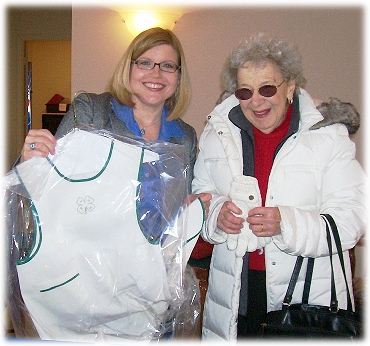 |
 |
4H Agent
Cathy Toole displays the 4H Apron made by Rose
Barmore in 1935 at the Celebrating Extension
Memories program held this past Sunday at Twin
Oaks Assisted Living. The apron was an amazing
piece of stitchery with French seams and
handmade buttonholes and will be used as a
learning tool at the current 4H sewing classes
being taught.
|
Over 100
past, present and future Extension Volunteers
enjoyed reminiscing over the many 4H Scrapbooks
and memorabilia displayed at the Celebrating
Extension Memories Program. The purpose of the
program was to recognize the many faithful
Extension Leaders who have made a proud history
for Extension in Henry County. The first
Extension Agent in Henry County was Carl Malone
who started in 1925 thanks to forward thinking
of J.C. Helburn the President of the Eminence
Chamber of Commerce who talked the Chamber and
our local banks into providing the funding to
get Extension started. The Henry County Local
provided Carl with office space and a desk and
the rest is history!
|
 |
Attending
the Celebrating Extension Memories program
were Jerri Cockrel (Home Ec Agent
1973-1985), Maryellen Garrison (Home Ec
Agent 1986-present), Steve Moore (Extension
Agent 1974-present), Alice Thompson
(Extension Secretary 1978-1988), Katie Sue
Yount (Extension Agent 1964-1972), Jim
Prewitt (Ag Agent 1967-1983), Cathy Toole
(4H Agent 1997 to present). Not pictured but
present is Sheila Atchison (Extension
Secretary 1973-1978), also not pictured is
current Secretary Annmarie Ivers (Extension
Secretary 1988 to 2011). This group
represents 172 years of Service to the
Cooperative Extension Service! |
|
|